
This is a study on the pythagorean movement in antique Southern Italy. The very name of „Italy“ came from today’s Calabria. This peninsula took at first the name of „Italia“ from one of its‘ legendary king or chieftain Italos, which led the little poeple of the Oenotrians.

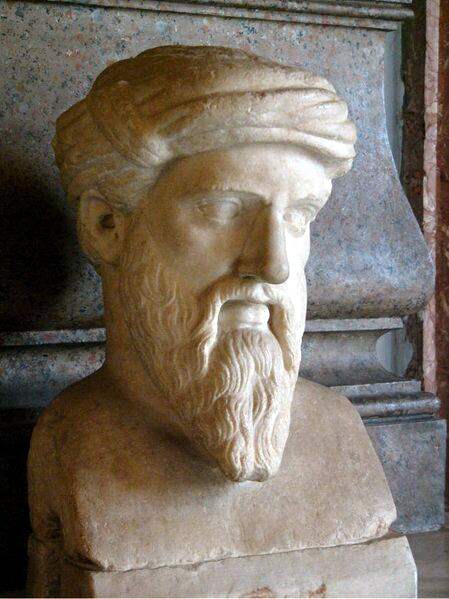
Chapter 1: Pythagoras of Samos (580/570 – 495): life and ideas according to ancient sources
According to a fragment (Porphyrios 9) the writer Aristoxenos tell that Pythagoras left his native island of Samos, because he found the tyranny established by Polykrates abhorrent. Because of his love for liberty Pythagoras migrated at the age of fourty to Italy (Kurt von Fritz: Pythagorean Politics in Southern Italy 1977, p.17).
Porphoyrios quote Aristoxenos also in fragment 22; according to him Lacanians, Messapians, Romans ans Peuketians searched Pythagoras for his advice. The cities of southern Italy (like Kroton, Sybaris, Katane, Rhegion, Himera, Akragas and Tauromenion) made under his influence liberal laws with the help of Charondas and Zaleukos. And the tyrant Simiros of Kentoripe accepted volontarily to step down and to distribute his wealth to his sister and fellow citizens (Fritz, p. 18). According to ancient sources like Aristoxenos, Iamblichos and Porphyrios Pythagoras influenced the content of numerous constitutions throughout southern Italy and Sicilly, like those of the Lucanians and Messapians (Fritz, p. 19). The antique sources (Diogenes Laertios VII, i, 16 , Nikomarchos, Porphyrios 22 and Aristoxenos) are describing Pythagoras as a bringer of peace and freedom, which influenced on the local legislation like thuse in Zaleuos and Charondas (Fritz, p. 20).
According to Iamblichos, Pythagoras, as an old man, refused the admittion of Kylon, a rich and influential Krotonian. Kylon and its followers acted hostile toward Pythagoras and its order. Pythagoras seek refuge in Metapontum and died there. After the death of the founder of the pythagorean order, the pythagoreans are still in an state of enmity with the Kylonians (Fritz, p. 11). But, always according to Iamblichos, at the end the pythagoreans became finally so influent in southern Italy, that some poleis like Kroton came under the rule of pythagorean administrations (Fritz, p. 11f.). According to Aristoxenos and Iamblichos 248-251 descriptions of the leadership-style of the Pythagoreans they stressed that they supported, as freedom-lovers, a rather liberal type of governing. Kylon was on the other not a popular leader, according to the antique authors, but a rich debauchee. According to Iamblichos, Pythagoras, as an old man, refused the admittion of Kylon, a rich and influential Krotonian. Kylon and its followers acted hostile toward Pythagoras and its order. Pythagoras seek refuge in Metapontum and died there. After the death of the founder of the pythagorean order, the pythagoreans are still in an state of enmity with the Kylonians (Fritz, p. 11).
Chapter 2: The Pythagorean Order after Pythagoras‘ death
Afterwards, always according to Iamblichos, at the end the pythagoreans became finally so influent in southern Italy, that some poleis like Kroton came under the rule of pythagorean administrations (Fritz, p. 11f.). According to Aristoxenos and Iamblichos 248-251 descriptions of the leadership-style of the Pythagoreans they stressed that they supported, as freedom-lovers, a rather liberal type of governing. Kylon was on the other not a popular leader, according to the antique authors, but a rich debauchee who took not a political, but personal vengence on the pythagorean order. The pythagoreans, after the death of Pythagoras seemed to be demanded for occupiying important political positions in the administration and government of the poleis in southern Italy. Albeit, Aristoxenos kept quit on the question if the Pythagoreans actually wanted to have political influence or even become rulers of poleis (Fritz, p. 16).
The rule of the pythagoreans in Kroton ended with an terrorist attack: the Kylonians set on fire the house of the athlete Milon, where the Pythagoreans hold a political meeting there. Only two of them survived and the leaders of the Pythagoreans in Kroton died. In the aftermath of the Krotonian Catastrophe, the city of Kroton seemed to hae taken little interest in the fate of their former rulers and the crimes of their assassins. Kurt von Fritz thinks that the Pythagoreans in Kroton hoped that their allies, the other pythagorean rulers in other cities, would come to punish the murderers (Fritz, p. 12). The pythagorean rulers could, according to Fritz, maybe not so easily decide such heavy decicsions on war and peace without risking a revolution. The will to support and avenge their allies was probably there, but the author didn’t mentioned the reasons of their „neglect“ (Fritz, p. 12f).
The two survivors of the fire were Archippos and Lysis. They suvived as „young and ablebodied“ (Fritz, p.12). The former went to Tarentum, his native city, while the latter emigrated to Achaia and afterward to Thebes, where he became the friend and tutor of Epaminondas before dying of old age. After the attack in Kroton, the Pythagoreans in the polis of Rhegion wanted to regain political influence and organised in the south calabrian city their new headquarter. After further deterioration of the political situation, they all left Italy or at least lost their influence there (Fritz, p. 13, 15). The last Pythagoreans wanted to preserve the old costums, as well as the pythagorean doctrines in their exile, even while the schooll was slowly dying out, as Diogenes Laertios and Aristoxenos wrote it (Fritz, p. 14).
Julien Sita and an informal study group, August 6th 2021.
 New Ideas in public forum