
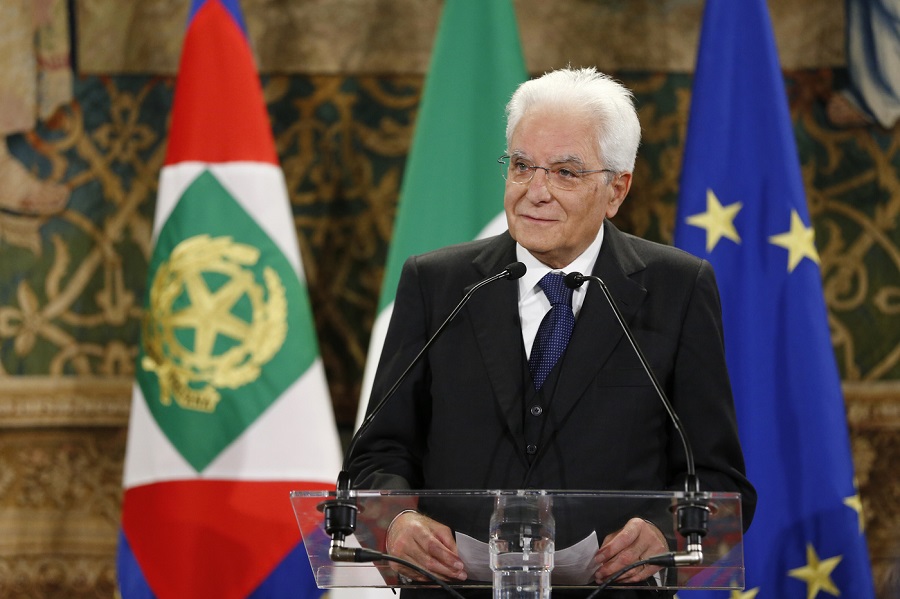
Source: https://www.oasport.it/2021/07/calcio-sergio-mattarella-presente-a-wembley-per-la-finale-con-linghilterra/.
The incumbent Prime Minister Mario Draghi, the incumbent Justice Minister and former university professor Mara Cartabia, the historian and former Minster for International Cooperation and Integration Andrea Riccardi and the magistrate and former Vice President of the Constitutional Court seem to be the favourite nominees for the italian presidential election of January 24th 2022.
During the last thirty years the position of president of the italian republic has become more important to balance instable party politics.(1) After the COVID-19-crisis Italy needs a head-of-state, which is able to make important decisions in turbulent times. Mario Draghi, being premier since 2021, seems to be successfull in having mastered the COVID-pandemic, pushing high rate vaccination and flourishing the nation’s economy. A presidential mandate could mean a new begining for Italy in a post-COVID-19-context or also constinuation of the important works which did Giorgio Napolitano and Sergio Matarella.
The problem is which deputy should act as premier instead of Draghi? Next year, no later as the first June 2023, there will be a new parliament to vote, which will also install new ministers. Draghi doesn’t want to be premier, but have to nominate the next. This presidential election is like a prelude to an election which could cement a new political culture in Italy or hopefully the begining of a post-COVID-19-crisis-government.
Whatever the next italian era would be, italians have to make pressure in order to get from their government a minimal set of important and deserved kept promises. Corruption and incompetence threw the peninsula into political and social decadence since 1992. They could promote some policies like researching and using Italy’s culture for economic and educational benefits, or digitalised commerce, or investing in climate protection, or making more free trade with Egypt, Nigeria and the swahili-speaking countries of East Africa, which could emerge as continental economic superpowers. Making political or economic accords with african countires could also be an interesting idea; free trade which profits both parties could limit emigration caused by misery. Italy did according to Jean-Claude Junker a remarqueble job during the refugee crisis by saving and taking in migrants. I twould be even more effective by boosting african countries‘ economies in the sahel and savannah regions as well as opening the doors for war and political refugees, victims of natural catastrophes like droughts, (potential) foreign workers and students interested in italian culture.
To come back to nowadays italian politics, I propose a post-Draghi government which should take as good as possible Italy out of this pandemic-crisis and enable elections next year. No snap elections, no useless parlamentarian blockades and no empty words, but just now much needed technocratical work. The next parliament is going to pick up and build on the pieced left from this COVID-crisis. The italian people has to make pressure on its politicians the next seven years to come. To manage a country correctly after a crisis, which has cost more than 120.000 lives in Italy alone, will determine important future conditions. There might be much to lose.
Julien Sita, January 24th 2022.
Footnote (1):
„In the heart of Rome, the Quirinal has been Italy’s most important palace for centuries. First, as the residence of the popes, then of the House of Savoy, and since 1946 it has been the seat of the presidency of the republic. In recent years, it has once again become Italy’s temple of power.
Italy is a parliamentary republic: the post-fascist constitution of 1947 is wary of an over-powerful head of state or government.
But with the nationwide investigation into political corruption of 1992 known as ‚Mani pulite‘ – and the consequent collapse of then mass parties – as well as a succession of political crises, the role of the president of the republic has become increasingly important.
Two examples are Giorgio Napolitano – nicknamed ‚King Giorgio‘ because he was president for almost nine years, from 2006 to 2015, a one-off in the history of republican Italy – and incumbent Sergio Mattarella, who was decisive in the rise of Mario Draghi as prime minister.
„The presidents of the immediate post-war period had a lower profile, the leading role was played by the political forces,“ says Marco Follini, a Berlusconi-era deputy prime minister.
„Over time, the function of the president has become more and more crucial. Partly because presidents have chosen to interpret their mandate in a way that is not merely notary-like. And partly, and most importantly, I would say, because the parties that dominated the political arena until a few years ago have lost much of their influence“, Follini added.
The head of state is elected by the members of parliament – Chamber of Deputies and Senate gathered in a single session – plus a number of representatives from each region.
Electing a president from one’s own political area represents a huge opportunity: more and more, it means influencing the general policy and balance of the country.“
Source: https://euobserver.com/news/153958 .
 New Ideas in public forum