Këschtlech Intelligenz (Gastbeitrag)

Flächendenkend Verbreedung vun kënschtlecher Intelligenz wärt hechstwahrscheinlech nemmen eng Saach vun der Zeit sinn. Wann nett am Privaliewen, dann op mannst an der Wirtschaftswelt. Schon den Karl Marx huet virausgesinn, dat Produktiounsmëtteln sech weider entweckeln. Eng Entreprise mat den Vierdeel vu der KI wärt aaner Firmen iwwertrumpfen, also mussen aaner Firmen sech dergeint wapnen kënnen.

En Staatlechen Departement fir Digitaliseirung keint durch sozial Experimenter ënnersichen wei KI and Menschen an der Wirtschaftswelt mateneen interageiren an Fraiwelleger fir dess Experimenter sichen.

Jonathan U. 22. September 2021.

Standard

Propositiounen fir Gemengepolitik (Gastbeitrag)

1. Flächendeckend Digitaliséirung

D’Wirtschaft an d’Privatliewen sinn hautzedaachs nëmmen nach durch en gudden Digitalsystem oofhängeg. Eng „gudd“ Machinerie ass an eisem Zeitalter awer nett eng dei mei aal ass wei fënnef oder zing Joer. Am Gemengeroot sollt den Kommunalpolitiker, deen sech
am besten mat Informatik and Technick auskennt en Departement fir Digitaliseierung leeden.

2. Save the seniors

Et gett ze vil Skandaler an respektlosen bis hin zu onmenschleschen Emgang mat den Senioren dei an Alterheem schon virkomm sinn. Och an deenen Luxurieisen; déi sinn Prisoen aus Gold. 2020 hat an engem Altersheem zu Niederkuer nemmen all dretten Senior eng eegen Toilette. Viel vun hienen hunn sech mam Coronavirus ugestach, woubai och Leit gestuerwe sinn.

Senioren sollten dofir aktiviteiten z.B. moolen, bastelen, Sport a.s.w. mat Spillschoulkanner maachen. Exkursiounen sollten sie an Busser maachen an am End vun Daag och Enterteinment kreien. Sie sollten nett mei den Routinen ennerworf sinn. Home Service anstatt Altersheem soll als Faustregel
gëllen an den Home Service soll permanent vun Gemengenbeamten iwwerwart ginn.

3. Mei Klima- an Naturschutz

Déiferdeng, als dei dëttgreisten Gemeng am Lëtzebuerger Land, kann fir all aaner Gemengen en Exempel ginn wei een esou schnell et soll emgoen fir d’existentiell Klimakris ze bekämpfen.

Den Verkaaf vun Solarzellen muss sech multiplizeiren. Et muss méi an den Recyclage investéirt ginn. Pecherten sollten zu Naturschutzpatrouillen emkonverteiert ginn. CO2-Steieren sollten emgesaat ginn. Delinquenen sollten niewend Geldstrofen och ëppes fir den Naturschtz maachen. D’Naturschutzgebidder sollten och ëffentlech verherecht ginn als Plaatzen wou fréier Tagebauten an Minnen woren an elo d’Deieren an Pflanzewelt sech ëremm frai entfaalen können. Umweltbeschmutzungen sollten mei streng sanktioneiert ginn. Fir den Klimaschutz muss och by the way am Rahmen vum Déierenschutz den d’Fleeschindustrie mei Klimafrendlech gemacht ginn: den Konsens ënnert den Klimaexperten ass, dat fir en efficacen Klimaschutz notwendegerweiss och d’Fleeschindustrie reformeiert muss ginn.

4. Streidereien teschend Noperen andämmen

Et gett emmer mei Streidereien tëschend den Noperen. D’Halschend vun den Geriichts-Affären zu Lëtzebuerg faalen ënner desser Kathegorie. Noperschaftsquerellen sinn laang nett mei Privatsaachen well
schon ëmmer mei oft Noperen d’Police geruff hunn fir Saachen dei nett verbueden sinn. Hätt en gewielten Kommunalpolitiker esou ëppes gemacht wier hien direkt zur Demissioun gezwongen ginn.

Den Staat an d’Gemeng muss opassen an sou Straidereien nett problematesch Noperen ongewollt ze ënnerstetzen.

5. Wunengspräisser sollten an meeschten Fäll eng Obergrenz hunn

Am Fall vun den Wunnengpräisser sollten sech mei Leit et sech leeschten eng Wunneng ze hunn oder zu leinen. Wunnen ass e Grondrecht: dess Evidenz ass eleng vun der Notwendechkeet vun der Wunneng beleet.

6. Educatioun soll mei hollistesch an efficace gin

Den Schoulsystem ass nett der moderner Zait ugepasst. Viel Themen an Beraicher fehlen an den Schoulen fir d’Kanner op d’Zukunft an dessen Johrhonnert vierzebereden.


Jonathan U. 22. September 2021.

Standard

Europe’s peripheries (S1)

Section 1 – resolutions for reformation

After 19 years of existence of the greather union after the cold war, the European Union must adapt with the times and focalise on the european citizens‘ demands. There are the resolutions for adapting the system:

1. Reviwing more democracy and giving new more performant technocratic impulses

Note: European citizens want more autonomy. This is why more and more of them vote for populists who promise them autodetermination and automanagement.

2. Abandon post-nationalism, install inclusive internationalism

Note: The pride of one’s origin is „in“ and the european leaders have to adapt to new modalities in order to be effective. These are the types of nations in human sciences: speech-nations, culture-nations, state-nations and civic-nations (Willensnation). German philosopher Jürgen Habermas argued that immigrants to a liberal-democratic state need not assimilate into the host culture but only accept the principles of the country’s constitution (constitutional patriotism).[5] [5]( ANNA STILZ. „Civic Nationalism and Language Policy“. Philosophy & Public Affairs37 (3): 257. )

3. Subventionate cultural preservation

4. Limit money and clientelism in politics

5. Reinvent party politics: less drama and more initiatives

6. Principles and values

Note: The European Union should also consider the national values of the 27 nations its consists. The french values for instance a strong social state system, job stability, workers‘ right, and secularism. We need to set up a national values committee to understand at union level also the values of latin, slavic, and nordic nations, so that a consensus can be more easily found and disagreements better avoided.

7. We need to regenerate Europe after the COVID-19 crisis


For further reading: Why We Need Inclusive Nationalism : Democracy Journal . Inclusive Nationalism › American Greatness (amgreatness.com) . Raj Kapoor, Mukesh, and Nostalgia for an Inclusive Nationalism – Kajal Magazine . 7 Nationalism (smu.ca) . The Inclusive Nationalist | The Indian Express . Nationalism: Inclusive or Exclusive by Arin Kaye (prezi.com) . How nationalism can actually help democracies – The Washington Post .

Julien Sita, September, 22 2021.

Standard

Eine Ontologie für das praktische Leben

METAPHYSIK: Das Nicht-Sein oder auch Nichts ist eigentlich das Anders-Sein bzw. das Andere. Als Vereinfachung sagen wir das „Nichts“, obwohl es ein absurder Widerspruch ist (oder zumindest nicht wirklich erkannt werden kann). Wir werden also grosso modo von einem absoluten Sein ausgehen. Dieses Absolute ist der Grundbaustein der Welt, denn die Welt hat sein und bedingtes Sein braucht meines Erachtens unbedingtes Sein. Aus diesem Einen, den unbedingten bzw. absoluten Sein, folgt eine Vielzahl an bedingten Seienden. Das Bedingte existiert zwar nur durch das Unbedingte, aber so wie die Dualitätslehre darlegt existiert auch das Unbedingte auch nur durch das Bedingte. Gehen wir davon aus, dass das Eine, als holistisches Konzept nicht ganz monistisch sein kann, weil zum Existieren auch das Gegenteil notwendig ist. Die Einheit kann also nicht ohne Vielheit existieren. Eine absolut notwendige Substanz bzw. Existenz kann nicht ohne eine bedingte Existenz existieren.

ETHIK: Gehen wir nächstes Mal von diesen grundlegenden Theorien über die Welt zum Alltag und zu Sonderfällen im menschlichen Leben über. (Fortsetzung folgt …)

Julien Sita, 22. September 2021.

Standard

Fiorentina o Ferrari ?

In the year 2039 the South-Alpine Republic was created after its secession from Italy. Through climate change the italian peninsula virtualy became an island. Genova and Venice became islands, while the five alpine regions became de facto autonomous in 2036 and officially in 2039. The young nation was relativly soon recognised by the italian motherland; the archipel lost anyway its connections to the north and isolated itself more and more, fearing the influx of climate refugees.

While the Free State of Bavaria had to let in millions of flood refugees from sunken northern Germany, millions of other refugees fled desertification, floods and natural catastrophies, as well as the total anarchy with daily fights for food they enabled to happen.

In the year 2040 the refugees crisis became ungovernable. More refugees came in than the authorities could put out. When undocumented immigrants came in they had even there to fight for their naked survival. Many had to do what rich person disired to avoid famine. The illegal immigrants became more and more the classic low paid working class during the climate crisis.

The same year the five governors of the new republic had to draft a new constitution. Of course asylium became a central question, but the collective leadership was divided on this issue. The conservatives wanted to restict the asylium right, whereas the left wanted more robust refugee protections. One of the five pleaded to resolve the asylium question after the climate refugee crisis, but his collegue protested and said he would only sign the constitution if the right of asylium will be respected. After months of negociations and chaothic governance at the same time. The five governors ratified on Christmas Eve the „Great Constitutional Charta of The Serene South-Alpine Republic“.

As one of the five I was pretty proud of my work, even when the special articles of climate crisis were one of the most obnoxious articles of legislations I have ever seen. Refugees kept their rights of asylium, but only when they worked for the minimum wage. I had there very much difficulties to reconcile my humanity with the economic world. Meat consuption was prohibited under the age of sixteen and even a car driver could not buy or eat meat. We had to restrain pollution through traffic and meat industry. We had no choice, but to choose between two consessions.

January, 10th 2041, the first south alpine citizen’s congress held its very first session. The ministers were confirmed and the creation of a scientific council to advice the congress and ministers on the climate crisis was also virtued by the congress. One fanatic from the northern league wated to rename the country to „Padania“ but his motion didn’t passed. The silver-shining Star of Venus in front of a black gear wheel and behind an olive background became our the national flag. The national currency became the alpine florin (AF). Seven great strees should also be build to enable transport after the flood. During the UN general assembly, the minister of exterior affairs had to condamn, sanction or appeal for an embargo against climate-unfriendly states. The congress should become bicameral in two years and divided in a Great Council and a Senate. At least, after a long debate they also voted for the budget, after two ministers fought with their own swings of fists to increase their ministerial budget. One of the two was impeached the day he became minister. After the budget vote, we decided also to make a law, as foreseen in the consitution, to divide the south alpine citizens into drivers and meat eaters. The drivers‘ licence and the meat eater licence were born.

After this day we politicians had to control radical mobs who wanted more climate protection or no more restrictions for climate protection. This winter should have been a moment of joy and celebration. We had founded a brand new nation. Instead the south alpine national guard and elite military police had to protect we lawmakers during every congress session and even in private.

One night I was dining with my family, when I was informed that a terrible riot brought the capital city into a state of civil unrest. Even the military could not control some pillaged and burned quarters. This night the city was lost. I was hiding in one house after the other fleeing potential murderers with my body guards. My family and friends had to go out of the city, while the killers hunted me. The first two hours of the Great Chaos (Grande Caos) were terrible. Fifty of my fellow lawmakers and three times more police agents were killed or wounded. I could not understand how it came so far and even less why the security forces didn’t assemble when the whole country was more than three hours under shock. I had to hide in and then defend a local police presidium. Some of the intruders were heavily armed. I understood, that a part of the military was complicit in this insanity. It was not only an insurrection, it was a coup d’Etat. After four hours most barricades were breached or deserted. None of the two sides could make a decesive move. It was a stalemate. The city was bruning and ashes darkened the air concealed the full moon and the cloudless night sky.

After five hours of insurrectional fight, admiral-in-chief Armando Alfredo send the marines into the capital city. Even the most couragious soldiers feld unwell when they see this tremendous tragedy in a city of chaos and carnage. Everything seemed lost, even when the sailors began to disband the hords and recapturing their first city-blocks. Admiral Alfredo send a message to the mob. It was an ultimatum. The leaders of the mercenaries and gangs didn’t took the marine serious… until they advanced heavily armed and supported by the cities population, they encircled the criminals and took thousands prisonners. Six hours after the violence began, me and my friens left the police presidum. I could barely breath the air. I heard all the rest of the night cries of desperation and pleads for help. The streets looked like a battlefield full of corpses and knee deep in blood. The culture of political polarisation brought chaos and tens of thousands dead, wounded or hopeless. Instead of speaking like civilised people we acted like barbarians.

(to be continued …)

Julien Sita, September, 22nd 2021.

Standard

Top polluting countries and international court/sanctions

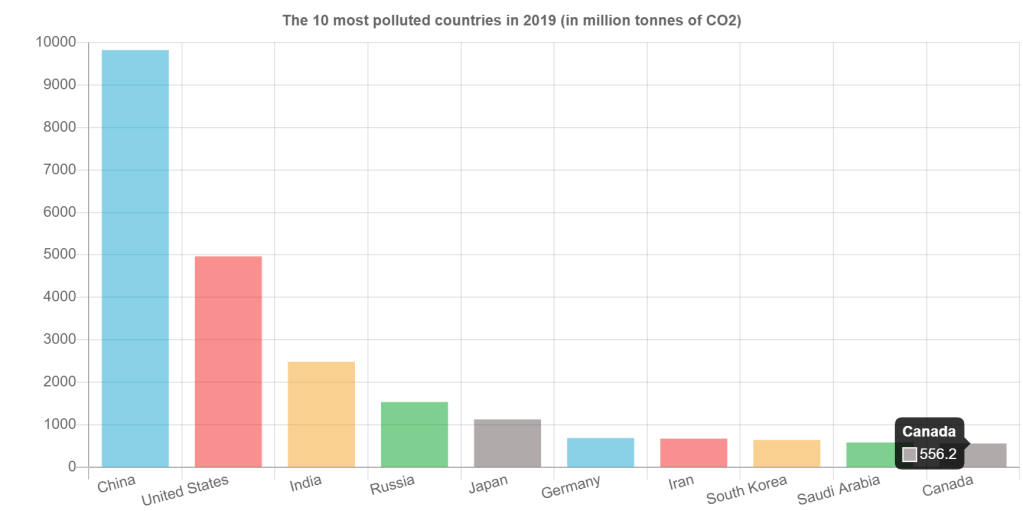
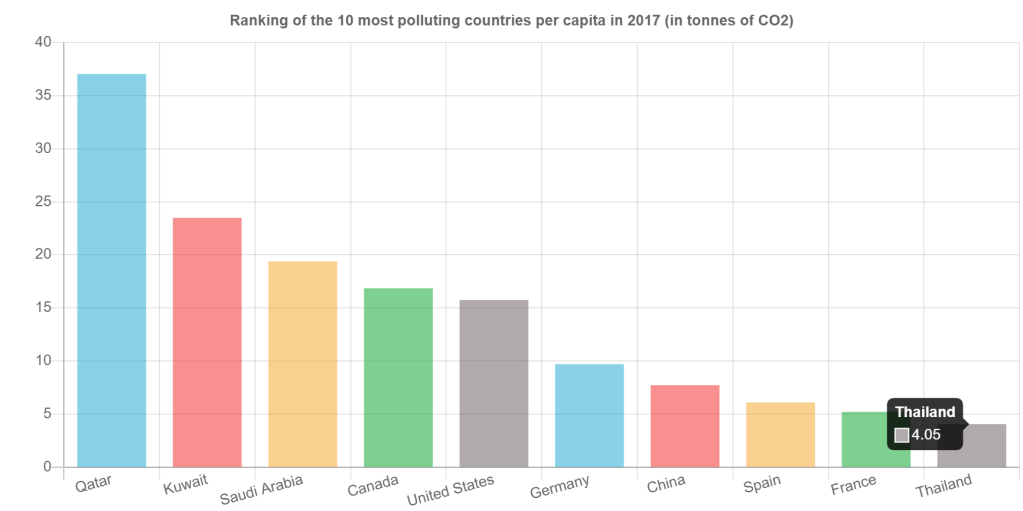
The ten most polluting countries are reponsible for half of the 34,1 million tonnes of CO2 produced in 2019. These, as well as those who are polluting at most per capita, could face international judiciary problems. More and more courts in developped countries are condamning their governments for not doing enough against the climate change crisis. Maybe some countries will face accusations before the international court of justice or even condamation from the United Nations‘ General Assembly. The klimax of this evolution would be sanctions or even an embargo. Obviously every country has to make concessions, or else no country will act. On the one hand, if most countries make concessions and the great polluters don’t, there will be tensions; I am pretty sure.

Source: https://climate.selectra.com/en/carbon-footprint/most-polluting-countries#air-pollution and BP Statistical Review of World Energy 2020 .

Source: https://climate.selectra.com/en/carbon-footprint/most-polluting-countries#air-pollution and Statistica.

Julien Sita, September 15th, 2021.

Standard

European Cyber-Defence

We need to form a pan-european cyber military and police force to protect us from „cyberwarfare“. Some american security experts fear more cyberattaks from their ennemis than a new coup d’Etat attempt. It is time to make Europe more secure. Not necessarly with an pan-european army, but surely with a cyber defence force as a vital part of the modern military. (And this is only the beginning, I am sure battle robots will be used by the military, if we accept every bad government to grab power illegally or through primitive populism.) If we want a combined european and modern defence force, we have to examine which country wants more and better technology for its military and if this country is dangerous and how we could build better military tech or force a rogue state to abandon its dubious military plans. The european comission may have more success with this important issues, than with the concept of an european army. By the way the EU wants more digitalisation, so security should also be a part of this programme.

Julien Sita, 15th September 2021.

Standard

Le pouvoir des idées/idéologies

L’économiste Rüdiger Frank pense être sûre que le régime de la Corée du Nord ne s’est pas effondré après la Mort de Kim Il-Sung et les grandes famines qui ont lui dans les années 1990, car l’idéologie officielle maintenait le régime en vie. Ceci est assez impressionant à quel point les idées sont si puissantes, qu’ils ont pu être le pillier fondamentale d’une des dictatures les plus extremes de l’histoire contemporaine.

L’historien de l’époque moderne Lutz Raphael s’intéresse au structures de la société qui peuvent influencer les jeunes à trouver des choses bien ce que leurs grand-parents pourrait également trouver bien. Et cela, sans être consciament une personne conservatrice.

Le philosophe Slavoj Zizek nous explique, que les idéologies font tourner le monde et forment nos actions quotidiennes, sans que nous avont besoin d’être vraiment convainque d’une idéologie. On suit les principes idéologiques en espérant qu’ils marchent, même si on n’y croit pas trop. Le physiscien Nils Bohr ne croyait pas au mavais oeil ou à la défence contre celui-ci, mais on lui a dit que cette superstition marcherait même si on n’y croyait pas. Ainsi, il aurait eu un pendantif devant sa maison, pour se protéger contre le mauvais oeil. Zizek va même plus loin en déclarant la pensée idéologique comme „notre état naturel“: notre réalité est depuis le début vu avec une certaine subjectivité systématique. Zizek prône plus d’autonomie vis-à-vis des idéologies.

À mon avis, il faut combattre les idéologies qui peuvent légitimer la violence et l’arrogance. Les idées qui font agire pour la paix internationale, la cohésion sociale et l’écologie doivent cependant être promouvu.

Julien Sita, 15 septembre 2021.

Standard

Wirtschaftspolitische Essays

  • Werkzeuge der Obrigkeit

Die materiellen Bedingungen der Herrschaft einer Elite sind Land, Ressourcen (Geld, Essen u.s.w.) und Waffen. Da stellt sich die Frage wer diese besitzen soll. Land, Ressourcen und Waffen geraten immer mehr in den privaten Besitz. Aus einer Meritokratischen Perspektive soll jener mehr besitzen, der mehr leistet. Dies scheint eins-zwei Generationen noch zu gelten, dann wird immer mehr Geld nicht mehr verdient, sondern vererbt. Diese modernen Erbaristokratien schaden der Meritokratie zunehmend, weil sich inoffizielle Privilegien wie Korruption und Vetternwirtschaft immer weiter verbreiten können, was zur Kluft zwischen Arm und Reich führt. Zumindest Nahrungsmittel sollten jeden gehören und nicht wie Wasser als gewöhnliches Gut gelten um Profit zu machen. Das Problem ist, dass das Eigentumsrecht so sehr an Bedeutung hat, dass arme Schlucker nicht einmal aus fremden Mülltonnen Nahrungsmittel nehmen dürfen. Diese haben nichts zu verlieren, weil ihr Lebens auf Spiel steht. Privilegierte interessieren sich währenddessen immer weniger um das Wohl und Elend der Unterschicht. Dagegen muss sich die Mittelschicht wehren, denn die Unterschicht kann dies nicht und braucht breite Unterstützung innerhalb der Bevölkerung, die nicht zuletzt riskiert in die Armut schrittweise abzusteigen.

  • Korruption als Grundlage der Diktatur

Soziopolitische Institutionen und der Pöbel haben sich im Laufe der Geschichte mehr durch Geld als durch Werte leiten lassen. Somit haben steinreiche Königsmacher in Russland und andere Oligarchen auf der Welt korrupte Regierungen an die Macht gebracht und haben diese erhalten. Joseph de Maistre kritisierte die französische Revolution, mit dem Argument, dass nur höchst talentierte, reiche oder bewaffnete Leute in einer Gesellschaft weit aufsteigen können. Die Monarchie sei dagegen ehrlicher und mache nicht jeden vor, dass alle zur Elite gehören können. Der Elite anzugehören mag nicht für alle gelten, aber m.E. muss eine dubiose Elite von der Basis bekämpft werden, wenn ein soziales Desaster droht. Dafür muss der breiten Masse die Mittel dafür zur Verfügung stehen, politisch aktiv zu sein.

  • Ideologie(-kritik)

Die dominante Ideologie eines ist jener der Elite. Da kann man Karl Marx recht geben. Die Ideologie der Elite muss aber kritisch untersucht werden, vor allem, wenn das System, dass die Ideologie fördert, nur der Elite nützt und dem Rest der Bevölkerung eher verarmen lässt. Ideologien sind wichtig, denn wie die Religion setzen sie moralische Maßstäbe um das zusammenleben zu ermöglichen. Eine Ideologie wird dadurch gefährlich, wenn sie zum einzigen legalen Gedanken im Staat wird.

  • Gesellschaft und Identität

Während die Armut in Europa wächst, werden Lebensstil-Ideologien immer mächtiger. Neben den Superreichen der neuen Elite und den alten aristokratischen Dynastien steht darunter die Arbeiterklasse und das Prekariat. Während sich die Politik seit den 2010er immer mehr um Identitätsgruppen als um soziale Klassen beschäftigt, wird die Elite heterogener und inklusiver. Allerdings sind soziale Aufstiegschancen immer kleiner geworden. Das am wenig begüterte Drittel der Gesellschaft scheint sich zu einer fest etablierten Schicht geformt zu haben. Der Niedriglohnsektor wurde in Europa immer grösser. Mindestlöhne müssen sich der Inflation anpassen, sonst muss vor dauerhaften Armutsverhältnissen für einen breiten Teil der Bevölkerung befürchtet werden. Inklusivität wird aber zur business sucesss formula mit der in Zukunft die Armut bekämpft und die Wirtschaft gestärkt werden kann.

  • Reform!

M.E. wird es zu einer großen ökonomischen Reformation kommen und zwar nach der Ära des autoritären eurasischen Kapitalismus‘. Möglicherweise hat der Kapitalismus in 200 Jahren nichts mehr oder kaum mehr etwas mit dem Kapitalismus von heute zu tun.

Julien Sita, 25. Juli 2021.

Standard

Les lois pour ruiner une revolution

Loi §1 – Improvise après le reversement de l’ancien système sans avoir un plan concret

Explication: Après que les conspirateurs ont tué César en 44 avant Jésus Christ, ils ne savaient pas qui devrait gouverner Rome après la mort du dictateurs. Les autres tyrants qui ont pris le pouvoir après se sont comportés moins cléments que Césars en pratiquant des purges politiques. Marc Antoine, le bras droit de César, a pris le pouvoir avec les généraux Lépide et Octave. Au lieu d’arrêter les membres notables de la faction césarienne, les conspirateurs attendaient simplement que l’ordre ancien soit rétablie automatiquement (Jochen Bleicken, Augustus. Eine Biographie, 1988, 2000). Ceci fut une erreur; les césariens ont en profiter pour commetre un coup d’Etat et les membres de la faction républicaine qui dominait le sénat ont été décimés, exilés ou soumis.

Loi §2 – Ne pas renoncer au pouvoir

Explication: Napoléon, Toussaint l’ouverture, Bolivar, Kadhafi et tant d’autres ont trahi les valeurs de leur révolution en restant au pouvoir indéfiniment. Si George Washington ou Nelson Mandela auraient en profité de leur popularité pour rester présidents à vie, ils auraient été un exemple de plus qu’une révolution peut changer de Chef d’Etat, mais pas nécessairement de système politique.

Loi §3 – Ne pas conpter sur le soutient du peuple

(à suivre)

Standard